
Clinical evidence
Peer-reviewed publications on urine output monitoring
Observe Medical's systems are supported by peer-reviewed research across leading critical care journals, covering CAUTI reduction, nursing workflow, measurement accuracy, and clinical outcomes in adult and paediatric ICU populations.
Thirty years of research and market feedback behind our solutions
Our products are built on independent laboratory testing and peer-reviewed, clinically relevant data, in combination with the feedback we have received by partnering with the day-to-day users of our products, with three key focus areas: protecting the patient, optimising workflows, and offering an overall health-economic solution.
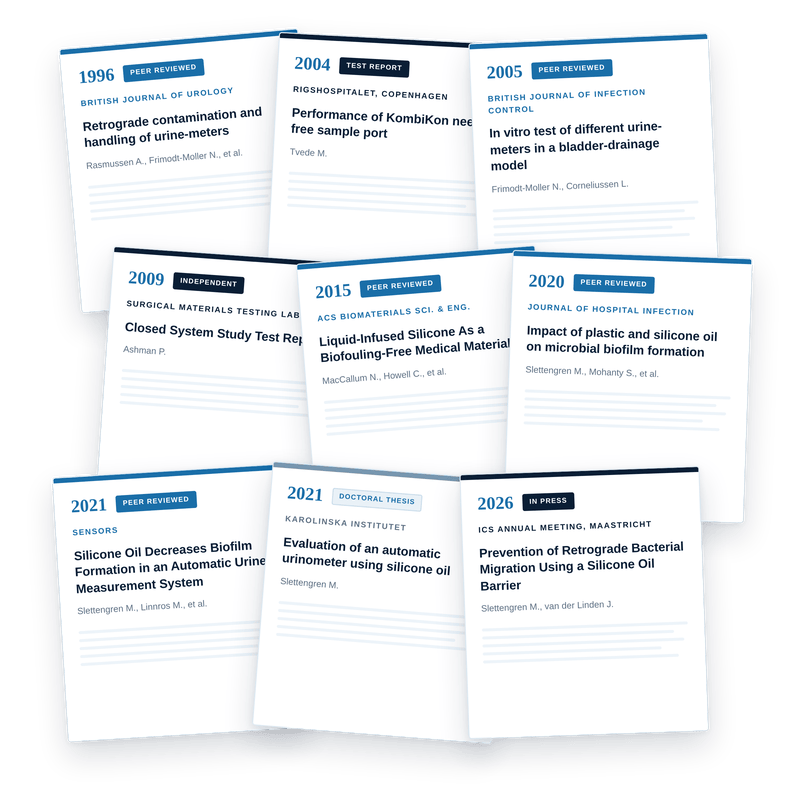
What it showed: a 14-day in vitro dynamic challenge in which a prototype UnoMeter Safeti Max drainage system with a silicone oil barrier showed no detectable retrograde migration of Proteus mirabilis to proximal components, with biofilm confined to the collection bag and bag inlet.
Slettengren M., van der Linden J. Infection Prevention in Practice, 2026. DOI 10.1016/j.infpip.2026.100585
Read the study →What it tests: whether a silicone oil barrier prevents bacteria from migrating back up a urinary drainage system over a 14-day laboratory model.
Slettengren M., van der Linden J. Accepted for publication May 2026. To be presented at the ICS Annual Meeting, Maastricht, October 2026.
Results available after presentation
What it showed: Silicone oil in the measuring chamber significantly reduced the capacitance increase caused by albumin and free haemoglobin coating, the mechanism by which protein and blood in urine degrade measurement accuracy.
Slettengren M., Linnros M., van der Linden J. Sensors, 2021, 21(2), 445. DOI 10.3390/s21020445
Read the study →What it covers: The full academic evaluation of the automatic urinometer, drawing the individual studies together into one body of work.
Slettengren M. Doctoral thesis, Karolinska Institutet. Published December 2020, defended January 2021. ISBN 978-91-7831-997-8
Download the thesis (PDF) →What it showed: How different device plastics and a silicone oil layer affect microbial biofilm formation on medical device surfaces.
Slettengren M., Mohanty S., Kamolvit W., van der Linden J., Brauner A. Journal of Hospital Infection, 2020, 106, 155-162. DOI 10.1016/j.jhin.2020.07.011
Read the study →Why it matters: the foundational surface science showing that liquid-infused silicone resists bacterial biofouling. This is the principle the silicone oil barrier is built on.
MacCallum N., Howell C., Kim P., Sun J.D., Friedlander R.S., Ranisau J., Ahanotu O., Lin J.J., Vena A., Hatton B.D., Wong T.-S., Aizenberg J. ACS Biomaterials Science & Engineering, 2015, 1(1), 43-51. DOI 10.1021/ab5000578
Read the study →What it covers: a follow-up laboratory comparison of ascending contamination across different urine meter systems.
Frimodt-Møller N., Corneliussen L. In vitro test of ascending contamination in different urine meter systems. Study report, Department for Microbiological Surveillance Research, 2011.
Report on file, available on request
What it covers: Closed system testing performed by the Surgical Materials Testing Laboratory, an independent UK medical device testing facility.
Ashman P. Closed System Study Test Report. Surgical Materials Testing Laboratory, Princess of Wales Hospital, 2009.
Report on file, available on request
What it showed: In an experimental bladder drainage model, how well a urine meter prevents ascending contamination depends on how the meter itself is constructed.
Frimodt-Moller N., Corneliussen L. British Journal of Infection Control, 2005, 6(5), 14-17. DOI 10.1177/14690446050060050501
Read the study →What it covers: Independent microbiological testing of the KombiKon needle free sampling port at a university hospital microbiology department.
Tvede M. Performance of KombiKon needle free sample port. Department of Clinical Microbiology, Rigshospitalet, University of Copenhagen, July 2004.
Report on file, available on request
What it showed: Three urine meter systems compared for retrograde contamination and practical handling, both in an experimental bladder drainage model and in clinical use.
Rasmussen A., Frimodt-Moller N., Espersen F., Roed M., Frimodt-Moller C. British Journal of Urology, 1996, 78, 187-191. DOI 10.1046/j.1464-410x.1996.00176.x
Read the study →What it covers: A 14 day closed system test of UnoMeter Safeti Max carried out by Research Institutes of Sweden, the Swedish national research institute.
Research Institutes of Sweden. 14 day closed system study with UnoMeter Safeti Max. Data on file, Observe Medical AB.
Report on file, available on request